Her first offering of completely original material in 13 years, Natalie Merchant’s eponymous album is a triumph, writes Philip Cummins

Originally published by Entertainment Ireland. To read the original, please click here

Natalie Merchant album art

Natalie Merchant’s eponymously titled new album is a triumph.

Following 2010’s Leave Your Sleep, a concept project thematically focused on childhood, featuring British and American poems set to music, former 10,000 Maniacs singer Natalie Merchant returns with an eponymously titled and self- produced record, her first studio album of fresh compositions since 2001’s Motherland.

Opening track and flagship single ‘Ladybird’ is a beautifully mixed pop song brimming with soul. The verses feature almost minimal instrumentation, the bridge and choruses lifting off the ground with melodic multi- tracked backing vocals, lush strings and understated guitar scales, all of which could, in the wrong hands, could become overblown and overcooked.

The songs that follow are nowhere near the ecstatic pop heights of ‘Ladybird’; rather, ‘Ladybird’ is used as a shade to contrast the austere, mature and oak-y sounds of the following ten songs. A song full of aphorisms, ‘What Maggie Said’ is certainly one for Gillian Welch fans, its combination of Dylanesque wisdom and a memorable chorus shot through a finger- picked acoustic guitar full of references to other songs. There is also a sense that the 50-year-old singer- songwriter is aware of her influences; ‘Texas’, a restless, shifting minor- key tune, feels less like a song about the lone star state and more of an homage to Texas songwriters, such as Townes Van Zandt and Lyle Lovett.

It’s when Merchant moves out of her comfort zone that the record begins to take shape. Singing about New Orleans, which post- Katrina has almost become a song form in itself for many American songwriters, Merchant’s ‘Go Down, Moses’ is, perhaps, the most New Orleans- sounding tribute to The Crescent City, featuring more funk and boogie than at which you can shake a Dr. John record. Lyrically, it encapsulates the central themes of the record: those of resolving one’s self with the past for the benefit of what may lay ahead, or as Merchant writes “Well, I’m far too quick with the poison pen, / can’t believe I’m writing again after all these goddamned years.”

There are missteps: the jaded metaphor of ‘Black Sheep’ titles a song that is too derived from the slow, gritty jazz of Tom Waits at his barfly best. A closing trio of a silent movie- era ditty (‘Lulu (Introduction’)), a bookend to the lush pop of ‘Ladybird’ (‘Lulu’) and a beautiful, elegiac closer (‘The End’), however, are enough to merit Merchant’s beautiful, mature and memorable record a triumph.

FOUR STARS

Recently reissued by AED records for Record Store Day 2014, Roddy Frame’s 2002 album Surf is a slow- burning masterpiece that everyone should hear, argues Philip Cummins

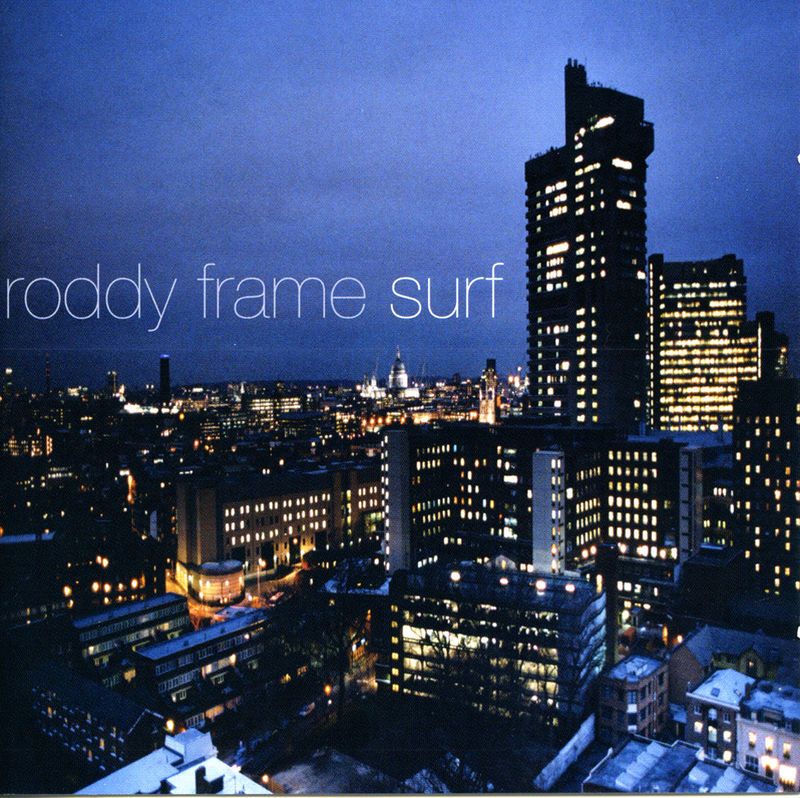
“Majestic”: Surf by Roddy Frame.

…I’ve written an album about day-to-day life in London; about being 38 and wondering what you’re going to do next.

RODDY FRAME claimed the above in a 2002 interview with the Guardian’s Will Hodgkinson before the release of Surf, his second solo LP proper. Hodgkinson interviewed the then 38 year- old Frame, best known as the wunderkind behind Aztec Camera, in his Notting Hill flat where he wrote and recorded all the songs on Surf, his masterpiece.

Taken from atop Burwash House on Weston Street, London SE1, the cover photograph by Hannah Grace Deller (Frame’s then girlfriend), depicts the London skyline in all its twilight beauty. To my eyes, the picture captures London on a dreary Tuesday night in November.

In this photograph, as in Frame’s songs, life is going on in other places: the focus is very much on the switched- on lights in rooms across the city. In the context of the bare instrumentation on the songs collected on Surf- solely voice and acoustic guitar- Deller’s photograph, if anything, feels like a point of view shot from Frame’s mansion- block apartment.

Starting point

Surf opens with ‘Over You’, a finger- picked tune that conveys a rejected lover’s restlessness in the wake of a breakup. As mentioned about the above quote from Frame, the album itself constantly gives a sense that life is continuing in other places across London in spite of the songwriter’s craft of focusing- in on frozen moments in time. No better an example than the line ‘heard you were out, SW3 / talking about how you were over me. Similarly, the song’s final couplet (Me stuck on the strand, trying to get through / And make myself understand that I’ve got to get over you) provides the perfect starting place for the albums’ succeeding ten tracks.

Surf‘s title track slows down the pace ever so slightly. Arpeggio’d chord and long vowels in the lyrics give a the sense of yearning that Frame’s words conveys.

Again, however, the focus is very much on London albeit viewing the city, now, through welled- up eyes (The east end squares’ve grown cold and loud / since I lived there with the twilight crowd / The west end lights have lost their wow).

Frame captures that sense of alienation in the city, of being a small fish in a huge pond and craving intimacy, beautifully in the chorus of ‘Surf’ (When I was young the radio played songs for me/it saved me).

‘Small World’, best known as the theme tune from hit BBC comedy series Early Doors, ends an opening trio of songs that nail the tone of the record, lifting the mood just slightly. Frame’s peppers Hopper- esque images of night-hawks in London town throughout the lyric and his voice is simply stunning on this song; his effortless falsetto blending beautifully with the verses, sung in lower octaves. Like ‘Tough’, ‘Small World’ was, perhaps, mooted as a possible single.

The centrepiece

‘I Can’t Stop Now’ is one of the most important songs on Surf and a song that is at the thematic core of the record. Serving as the breaking point of the tension built up in the record’s opening side, ‘I Can’t Stop Now’ is a good example of Frame’s ability to judge the timing of subtle changes in the dynamics of a song. One of the most cathartic and climactic lines in the song (’til the first tear falls) stands alone from the busy opening verses, giving that line more emphasis and more weight. Similarly, the key change in the final chorus is beautifully timed and renews the tone of the chorus; where the listener heard desolation and sorrow in the previous choruses, the listener now hears a tone of acceptance and defiance in the same chorus, two steps higher. It’s a stroke that only a singer and a songwriter of Frame’s talent and experience could pull off.

Influences

Throughout Surf, Frame wears his influences lightly, though obvious exceptions are…well, obvious. Paul Simon looms large on Surf.On ‘Abloom’, which also has qualities in the chord patterns and the finger- picking that recall Nick Drake, there is a hypnotic quality in the rhythm and harmony; there is a jazz-y feel to it. Simon, however, is also there in ‘High-Class Music’, the title of which also carries Simon’s influence in its wise use of demotic language. The opening finger- picked phrases of each verse immediately recall Simon’s ‘The Boxer’. Add in a fast- paced abab rhyme scheme and Paul Simon’s influence in Frame’s writing is undeniable.

Furthermore, Simon is there again in ‘Mixed Up Love’, one of the stand- outs from Surf; the descending scale of the verse is quite similar to the intro to Simon’s ‘America’. ‘Mixed Up Love’ encapsulates everything that Frame claims about “…being 38 and wondering what you’re going to do next.” in his Guardian interview. The end of the chorus, just as in ‘I Can’t Stop N0w’, contains a wonderfully placed spoken line at the chorus’ end: you’d think that I’d know better now.

Finishing on ‘For What It Was’, Frame exudes the kind of simplicity and concise song-writing only found in country music. There’s a soulful, gospel quality to ‘For What It Was’, rich with spiritual imagery and Frame’s own confident, wry voice (And if the prophets knocked my door with all that heaven held in store, / I’d probably ask to see a sample).

Surf

Not since Paul Simon’s Hearts and Bones nor Bruce Springsteen’s Tunnel of Love has there been an album by a singer- songwriter that has explored themes of love, heartbreak and identity as skilfully and masterfully as Roddy Frame has on Surf. One struggles to think of an LP that is so masterfully crafted from the last 10 – 15 years.

So has Surf been unfairly overlooked? Of course, it has though it’s easy to see why. In 2002, the music press was still feverishly long over the so- called new rock revolution, of which only Jack White emerged as a real, world-class, all time talent. The Strokes burned themselves out; the less said about the also- rans the better.

Coldplay, too, had just launched A Rush of Blood to the Head, their best record to date, which took them directly into the big leagues. Combined, Chris Martin and Co.’s world- beating aspirations and the distortion- dark sounds from New York, LA and Detroit drowned out the fragile, natural tones of Frame’s Surf.

If it was Frame’s ambition to freeze 11 moments from London’s bustling, restless and constant metropolis, he succeeded admirably, capturing that sense of heartbreak, of loneliness and relentless self- examination like few songwriters before him. Surf is, quite simply, one of the most moving, spellbinding and memorable collection of songs I have heard in recent years.

Born again: John Mayer’s fifth studio album, ‘Born and Raised’, is a return to form.

Having almost successfully recovered from his disastrous and downright bizarre February 2010 Playboy interview, removing himself from Hollywood’s A- list party circuit and selling his bi- coastal homes L.A. and New York in favour of a self- imposed, frugal lifestyle in Bozeman, Montana, John Mayer has spent the ensuing time eating humble pie; nowhere is this more evident than on his fifth record, Born and Raised, his most focused, mature, honest and fully realised album to date.

On opener ‘Queen of California’, Mayer sets out his stall; this is an album in the vein of the big, era- defining folk albums of the 70’s, such as Neil Young’s Harvest, James Taylor’sSweet Baby James and the debut solo records of Stephen Stills and Paul Simon. Mayer’s subtle finger- picking and references to Neil Young (Looking for the sun that Neil Young sung/ After the gold rush of 1971), Blood on the Tracks– era Bob Dylan (If you see her, say hello) and Joni Mitchell (Joni wrote Blue in her house by the sea/ I got to believe there’s another color waiting on me) all convey a move towards the confessional, folk song- writing that defined Mayer’s career with 2003 hit ‘Daughters’ but was subsequently sidelined in favour of the audacious blues chops he displayed on 2005’s live album, Try!, and the more restrained, soulful blues playing of 2006’s Continuum– arguably his best record- which earned him a place on Rolling Stone’s New Guitar Gods, with the nickname “Slowhand Jr.”- a favourable nod to that other blues guitarist who crossed over to modern, mainstream audiences.

Throughout Born and Raised, Mayer shows an astute understanding of styles and forms. Like ‘Queen of California’, ‘Something Like Olivia’ uses that most humble and honest of all song forms; 12- bar blues. ‘Something Like Olivia’ finds Mayer attempting to resolve his devil- may- care, man- about- town- urges of old, with his newly found moral order and conduct. Of course, this turns out to be a theme at the heart of the record; that one person’s redemption can only be achieved by progressing past life’s unfortunate choices and by chalking those mistakes down to life experience. Mayer illustrates this best in ‘The Age of Worry’, a simple, AB- form song, which is laden with strong, Dylan-esque rhetoric (Know your fight is not within/ Yours is with your timing/ Dream your dreams but don’t pretend/ Make friends with what you are).

Flagship single ‘Shadow Days’, the style and sound of which is clearly influenced by George Harrison and Jeff Lynne, is certainly the most colourfully arranged and produced songs on the first side. It is, however, the album’s title track, with harmonies courtesy of Graham Nash and David Crosby, which is one of the strongest songs here and might just be one of the best songs that Mayer has yet written. The gorgeous harmonies, Mayer’s soulful vocal inflections and the acceptance and honesty of his lyrics all melt fluidly and forcefully to conclude the first side.

The second side finds Mayer embracing slow- tempo numbers that, again, tip the hat to his many writing influences. Despite it’s- frankly- awful title, ‘Love is a Verb’ is exactly the kind of song that Mayer needs; a slow burning, breezy, ‘Wonderful Tonight’- mode Clapton song. This is followed by ‘Walt Grace’s Submarine Test, January 1967’, a song, which in its rhymes, its unusual, intriguing, opening saxophone arrangement and narrative- driven lyrics of hope and aspiration owes much to Paul Simon. Darkness reigns over the brooding ‘Whiskey, Whiskey, Whiskey’, the chorus of which recalls Jeff Buckley’s ‘Lover, You Should Have Come Over’.

After showing restraint and subtlety in his playing throughout the record, Mayer finally lets himself off the leash on ‘A Face to Call Home’ with some of the most operatic playing on the record that, temporarily, shifts away from the Americana sound that dominatesBorn and Raised, for a delay- laden, stadium- rock outro, reminiscent U2’s The Edge.

The recurring theme of identity and the inevitable dichotomies- born and raised, folk and blues, fame and anonymity, the public self and the private self- that dominate Born and Raised culminate in ‘Born and Raised (Reprise)’, an alternate version of the title track, which, here, is treated as West Coast folk ditty that is as enjoyable to hear as it must have been to record.

Despite going “Americana” and producing his strongest set yet, Mayer might be too divisive a figure in contemporary music to appreciated by fans of Neil Young and Ryan Adams; too unfashionable to persuade those music fans that he’s anything other than a Berklee College of Music- educated pretty-boy, who is molly- coddled by his major label and who is more famous for his appearances in TMZ, People magazine, US Weekly and many other celeb gossip magazines. On Born and Raised, however, Mayer does do enough to prove that there is substance in his song- writing and guitar playing. Now, more than ever, mainstream American radio and television- now more than ever- needs a major label, Billboard Top 100- topping song- writer and performer of Mayer’s talent and substance to enrich and subvert a mainstream dominated by vacuous, auto- tuned, shock and awe value, pop- tarts. The John Mayer of Born and Raised might even appreciate this dichotomy.

Paul Buchanan

Walking on air: Blue Nile singer- songwriter Paul Buchanan is back with his debut solo album, Mid Air.

In his essay ‘The Blue Nile: Family Life’, Marcello Carlin observes that “On every Blue Nile album there is a moment where time stops, and emotion laid open and bare”. Eight years on from The Blue Nile’s previous- some say last- ever- album High, Paul Buchanan, the band’s singer- songwriter, has finally delivered the solo album that many long- time fans of The Blue Nile have anticipated. Buchanan’s Mid Air is an album of thirteen, three- minute, piano- led songs and one instrumental, all of which get to straight to the heart of Carlin’s astute observation.

Recorded by Cameron Malcolm (son of long- time Blue Nile producer/engineer Calum Malcolm), the success of Mid Air is largely down to the compression and brevity of Buchanan’s songs, which are as condensed and companionable as short lyric poems. The minimal arrangements that adorn each song eschew the sometimes too slickly produced, glossy feel of subsequent Blue Nile records. Mid Air‘s opening title track features a beautifully restrained vocal from Buchanan, underpinned by light, electronic, orchestral strings. Like Tom Waits- whose collective influence of Frank Sinatra looms large on Mid Air– Buchanan delicately croons and plays simple, elementary scales to stunning, emotionally intense effect, most evidently so on album highlight ‘Cars in the Garden’.

Initially given the working title of Minor Poets of the 19th Century (after a book that Buchanan bought in his local Oxfam) Buchanan’s literate lyrics recalls Larkin (‘Wedding Party’), Plath (‘Two Children’) and Yeats (‘My True Country’). Before recording Mid-Air, a close friend of Buchanan’s passed on; no surprise, then, that, lyrically, the tone and mood of Mid Air is elegiac. Buchanan, however, extends the mournful tone beyond bereavement; ‘Newsroom’ is a lament for the last days of print journalism (Last out the newsroom/ Please put the lights out/ There’s no- one left alive), while ‘My True Country’, featuring one of Buchanan’s most impassioned and convincing vocal performances, celebrates an imagined paradise. The portrayal of urban loneliness in the full glare of neon signs during the night- time hours- a central and defining characteristic of a Blue Nile song- is mostly absent on Mid-Air, save for ‘Half the World’ and the superb album- closer, ‘After Dark’.

In Mid-Air, Buchanan has crafted an accomplished collection of beautiful, honest songs that, like Joni Mitchell’s Blue and Tom Waits’Closing Time, rely heavily on the strength of their lyrics, their simple arrangements, and humble, delicate, fragile, convincing vocal performances. A Mercury Music Prize nomination must, surely, be mid- air.

Also available in State.ie

Stephen Malkmus and the Jicks – Mirror Traffic

(Domino)

No doubt refreshed and inspired from Pavement’s 2010 reunion, Stephen Malkmus’s fifth solo LP finds the former Pavement frontman more cohesive and tune- based than 2008’s overblown and indulgent Real Emotional Thrash. Produced by Beck (that other poster boy for US indie- rock slackers), Malkmus’ 15-track, solo record – made up largely of accessible, three-minute pop songs – is a welcome return to the sound that made his music so endearing in the first place. Flagship single ‘Tigers’, with its opening line of ‘I caught you streaking in your Birkenstocks’ is more Pavement than Pavement themselves, while the slide guitars on the chorus are equally reminiscent of both Silver Jews and, indeed, Beck’s more roots-based material. The choice of an experienced songwriter like Beck as the producer has certainly paid off; throughout, Malkmus shows his range as a songwriter. ‘Senator’ is a reminder of Malkmus’ lyrical skills as a ribald social critic of Middle America, while ‘Asking Price’ and ‘Fall Away’ are amongst the most tender and cool songs that Malkmus has ever written.

Beck’s presence throughout the record is there, both musically and in spirit. The jaded folk/country of ‘No Is (As I Be Are)’ and ‘Long Hard Book’ could have easily been taken from the producer’s Mutations while the instrumental ‘Jumblegloss’ seems like a musical exercise between both artists. Although it might be three tracks too long and the second half lacks the punch of the first, Mirror Traffic will no doubt appeal to those currently caught up in a nineties nostalgia trip and is certainly Malkmus’ most enjoyable and infectious set of songs as a solo artist.

Originally published by State.ie

(Conchord)

In a telling lyric on his eleventh solo studio record, Paul Simon imagines God cruising down a highway in the Midwest of America, criticising American culture: “check out the radio, pop music station / That don’t sound like my music to me.” In one of many lyrics in which Simon uses a mythic figure to reflect his personal conflicts with America, it neatly sums up the tone of So Beautiful Or So What. Repeatedly throughout, Simon is reaching back into his musical past as a way of reacting to the present. Simon even delves back to the ‘40’s, sampling a sermon given by Reverend J.M. Gates on ‘Getting Ready for Christmas Day’. The jaunty opening track recalls Simon classics such as ‘Mother and Child Reunion’ and ‘Kodachrome’ and touches on everything from life in Blue Collar America to Iraq in just over four minutes. Re- uniting with Phil Ramone, who produced all of Simon’s solo records from 1972’s Paul Simon to 1980’s One Trick Pony, the feel of So Beautiful Or So What is similar to his early ‘70’s debut; it seems almost as if the record was recorded live, in a room.

Pushing 70 years of age, Simon clearly has mortality on his mind. Like many songwriters of his era, songs about birth, death and everything in between are sure at this point in his life. What makes Simon’s take on the subject, so refreshing is how he writes about the big questions with a humorous voice that is indelibly his own. In ‘The Afterlife’, he imposes witty, smooth, demotic tones on life after death: “Had to stand in line / just to glimpse the divine / what ‘cha think about that?”. Again, Simon reaches to the language of a bygone era and the coda of “Be Bop a Lula? Or ooh Papa Doo?” immediately recalls the iconic opening cry of “A-wop-bop-a-loo-bop-a-lop-bam-boom!” from Little Richards’ ‘Tutti Frutti’.

Unlike much of his output since Graceland, the lyrics, melodies and guitar parts are not overshadowed in the mix by the rhythm section. Simon returns to his songwriting approach of constructing the song before the rhythm; an approach which changed during sessions for 1986’s classic Graceland, whereby rhythm dominated and dictated the course of the song. Songs such as ‘Love and Hard Times’, ‘Questions for the Angels’, and instrumental ‘Amulet’- have no percussion at all, and there is no bass guitar anywhere on the record.

Lyrically, Simon is, as ever, concerned with the present state of America but is consistently using reference points from the past and in doing so write some of his most vivid and moving lyrics. His humorous and playful tone- particularly on ‘The Afterlife’ and ‘Rewrite’, a stunning song about a Vietnam vet writing a fictional happy ending for his autobiographical film script is akin to that other maestro of American Song: Randy Newman. The piano-led ‘Love and Hard Times’ is laced with the same sardonic humour of Newman’s ‘God’s Song (That’s Why I love Mankind)’. Where Simon’s “restless Lord,” says “…anyway, these people are slobs here / if we stay, it’s bound to be a mob scene”. A frank social commentator, Simon’s observations throughout the record ensure longevity.

An old hand at making records, Simon knows that the greatness of an album rests on the finishing side. ‘Amulet’, an elegant instrumental, bridges the raucous bluegrass of ‘Love is An Eternal Sacred Light’ with ‘Questions for the Angels’, easily one of his most tender and beautiful compositions. He finishes on the album’s title track, the recurring hammer, on the motif of which is reminiscent of the opening theme of Simon & Garfunkel’s ‘Mrs. Robinson’. By the end of the albums, ten tracks clocking at 38 minutes, it’s clear that Simon’s blend of bluegrass, shifting rhythms, poetic lyrics and confessional, solo acoustic centrepieces are almost a retrospective of his entire solo output. It’s also clear that he has crafted his most vital, most complete album in 25 years.

Originally published on State.ie

(Bella Union)

Belfast five-piece Cashier No. 9 couldn’t be further away, musically, from Two Door Cinema Club, the current darlings of the Northern city’s music scene. Referencing everything from The Byrds to Primal Scream, their widescreen sound and tightly-crafted songs don’t aim to “nail it” in three-minute pop songs, but instead, wrap themselves up in a groove that can bring them to the five-minute mark. For this quality alone, they immediately bring to mind Creation-era Primal Scream; a devotion to classic song structure but with the dimensions and grooves that have made significant electro records timeless.

Lead single ‘Goldstar’, with its nod to Phil Spector’s Wall of Sound, is an immediate, confident and ambitious opener, which even manages to pull off a harmonica solo (from Hollies’ sessioneer Tommy Morgan, no less) that could have gone badly wrong. Although the banal title of ‘Lost at Sea’ is off-putting at first, it shares the same thunderous drums and restless rhythms of ‘Goldstar’ and is an obvious single in waiting.

The bridge between their obvious ’60s, West coast leanings and ’80s & ’90s British indie rock becomes more evident with ‘A Promise Wearing Thin’, which recalls the melodic grandeur of Echo and the Bunnymen classic ‘Ocean Rain’. Meanwhile, the groove-laden, baggy-indebted ‘The Lighthouse Will Lead You Out’ bringing to mind mid-’90s era, Charlatans. Over the ten tracks, it’s the fusion of these influences that manage to keep the music fresh and exciting. The closing track, ‘6%’, a downbeat synth- drenched song, is an intriguing way to end the journey, and could very well signal the direction they take on album number two.

At the heart of Cashier No. 9’s impressive debut is David Holmes’ lush production, which skillfully adds textures and layers without resorting to the nostalgic, retro stylings that often date a record. Throughout, the multi-dimensional arrangements often recall Mercury Rev’s Deserter’s Songs and All is Dream. However, like the albums as mentioned earlier, it’s also grounded in the tight songwriting structures and styles that defined the Laurel Canyon songwriters of the ’60s / ’70s, like Neil Young, Crosby, Stills & Nash, Jackson Browne and Gene Clark. And while they lack memorable, inspiring lyrics that make use of the broad song forms they write in, these anthemic, big sounding songs could make Cashier No. 9 a surprise hit at festivals the world over.

Originally published on State.ie

Popical Island #2

(Popical Island)

Part of the charm of the second compilation from Dublin-based collective Popical Island is that they represent a throwback to a time when people queued up for records on the day of release, mixtapes were a welcome gift from fellow musos and Seattle, Washington, was the unlikely capital of rock music. In the wake of the synth- pop revival that has revitalized everything that was good – and bad – about the ’80s, Popical Island # 2 throws a knowing glance towards the ’90s; a time when a new alternative rock album that would define the decade seemed to come along at least once a year.

Diversity and range, within the pop form, is key to Popical Island’s latest release. While all the artists seem to share common ground, their leanings become more evident after repeated listens. Michael Knight’s quirky piano song, ‘Hang On, I Need To Count the Stops’ is clearly from the Ben Folds songbook, the chiming 12 strings that adorn Goodly Thousands’ ‘Kiss Me Upside Down’ recall I.R.S. era R.E.M., while ‘Candle’ by Squarehead should keep fans of The Shins happy. Three-minute pop nuggets aside, there are also left turns, such as Tieranniesaur’s ‘Here Be Monsters’, which is possibly the only track that isn’t defined by fuzzy guitars but by a tight, stomping drums and bass with sparse keys and vocals. In contrast again, Grand Pocket Orchestra and Johnny Fun & The Hesitations’ contributions owe their sound and feel to the many records that defined the Montreal music scene of recent years.

While many of the contributions here aren’t breaking any new ground, have little to say and, at times, are a too indebted their influences, there’s plenty here to enjoy and the mere nostalgia trip, alone, is worth the price of admission.

Originally published by State.ie

Arctic Monkeys – Suck It and See It

(Domino)

Having recovered from the lukewarm critical reception and the public indifference that greeted 2009’s Humbug, Arctic Monkeys have returned with an album that is, more than anything, an attempt to put them back in the public’s consciousness: an album full of big choruses, major keys and conventional pop formulae. Where Humbug was full of ideas but thin on tunes, this latest effort is quite the opposite. The fusion of its predecessor’s abstract lyrics and stoner-rock with the retro stylings of Alex Turner’s The Last Shadow Puppets forms the makeup of Suck It And See.

Disappointing at times, here, is that a band that had such a strong identity – a group that had been parodied and imitated when they first arrived with 2006’s instant classic Whatever People Say I Am, That’s What I’m Not – are revealing their influences far too easily. At times, the group is imitating other artists with what are, essentially, pastiches. The melody of opener ‘She’s Thunderstorms’ bears more of a resemblance to Richard Hawley, while the predictable and well-trodden G-D-C progression of ‘Black Treacle’ recalls the Byrds-esque pop of Teenage Fanclub. Add to this track three, ‘Brick By Brick’, an unremarkable throwaway homage to The Vines, and you sense that this is already a false start. The chorus of ‘The Hellcat Spangled Shalalala’ offers a shot in the arm and will, no doubt, be a staple of future live sets.

There is, however, flatness in the middle of the record. At times, you can’t help but feel that they’ve lost the bite, spike and edge that not only defined the best moments of Favourite Worst Nightmare but which made them so attractive in the first place. ‘Don’t Sit Down ‘Cause I’ve moved Your Chair’, ‘Library Pictures’ and ‘All My Own Stunts’ are a trio of flat, distortion-led tracks that find the band reverting to their already exhausted Queens of the Stone Age influence. Turner’s litany of intended witticisms on ‘Don’t Sit Down…’ (“Run with scissors through a chip pan fire fight”) never really connect. They aren’t funny and fall wide of the mark, much like the “Give me an eeny meeny miny moe/or an ipp dipp dogshit rock n’roll” lines of ‘Library Pictures’. On ‘Love is A Laser Quest’, Turner’s voice isn’t strong enough to carry a song with such a slow tempo.

It’s a given that Turner could no longer go on singing about fights at taxi ranks or Saturday nights out in modern Britain, but somewhere during his transition in his writing style, he seems to have lost the unique talents he once had for rhyme, sharp concrete images, wit and outward-looking lyrics. While the opening words of ‘Piledriver Waltz’ seem impressive (“I etched the face of a stopwatch on the back of a raindrop”), the pseudo-poetic, pseudo-psychedelic wordplay too readily recalls John Lennon’s opening lyrics to ‘Across the Universe’ and the song itself feels like a collage of classic ballads.

The highlights on Suck It and See are those songs lead by guitarist Jamie Cook, who seems more inspired than Turner when he’s playing the higher strings. Fired up, no doubt, by the great, Northern English guitar players, he shines with the Johnny Marr-type chime that ends and defines the Pixies-influenced ‘Reckless Serenade’, which is among the most memorable songs here. Also particularly memorable and infectious are the guitar parts that drive album closer ‘That’s Where You’re Wrong’. It would be easy to dismiss the song as sounding like Echo & The Bunnymen covering LCD Soundsystem’s ‘All My Friends’ – which it does – but it works so incredibly well and ends the album on such an intriguing note that it’s hard not to admire what they can do with just two chords.

In all, there are some very well-crafted pop songs here that may win back those fans who no longer felt involved after their era-defining debut album. It’s certainly their best since Favourite Worst Nightmare, and a step in the right direction but quality control lets them down too often. Where they go next is anyone’s guess, but if Turner, lyrically, gains the inspiration and focus that Cook has here and if the band, collectively, regain their edge, there’s no doubt that album number five could be their best yet.

Originally published by State.ie

The Strokes – Angles

(Rough Trade)

Ten years on from Is This It and indie kids the world over are still sporting skinny ties, blazers, drainpipe jeans and beat-up Converse. Aside from influencing the stock of High Street fashion retailers, the garage rock of Is This It produced a wave of new bands, with even established acts like R.E.M. and U2 crediting The Strokes for the back-to-basics approach they both took on subsequent releases. Odd then, that the band that heralded the garage rock revival of the 2000s and epitomized CBGB’s rock should have lost their way as much as they did. Faced with the unenviable task of following up Is This ItRoom On Fire was full of familiar tunes by a band in cruise control, while First Impressions Of Earth was too long, overblown and lacking in character. Subsequent solo projects by all of the band members made little or no impression on the indie rock fraternity. All of which The Strokes are keenly aware.

There’s a confessional feel to Angles – on the album opener ‘Machu Picchu’ Casablancas sings “I’m just trying to find a mountain I can climb” – and The Strokes 2011 aren’t without humor. The album’s flagship single, ‘Under the Cover of Darkness’, is a tongue-in-cheek number and smacks of something of an in-joke for the band. The classic sound is lifted right out of Is This It – Casablancas vocal melody of the line “I won’t just be a puppet on a string” is an exact copy of “Well I’ve been in town for just about fifteen minutes now” from 2001 single ‘Last Nite’. In a mirror of that lyric, he lambasts Strokes wannabes and in turn the band’s slow development: “I’ve been out around this town/everybody’s been singing the same song for ten years”. As if to drive the point home the song even finishes in the same abrupt manner in whichIs This It’s ‘Take it or Leave it’ and ‘Hard to Explain’. A pastiche of Is This It, it may be, but it is also an opportunity that The Strokes take to confront their “definitive” sound to move on.

The main key to The Strokes’ development is how they’ve changed the way they operate in a band. Angles is reliable record – 10 tracks clocking in at just under 35 minutes. For the most part, the band produced the record themselves, and it’s also the first album with songwriting contributions from all five members. And within this tight and full frame, they blend their strain of garage rock with synth pop:  ‘You’re So Right,’ ‘Taken for a Fool’ and ‘Gratisfaction’ all recall Room on Fire’s more intriguing moments.

Meanwhile, the eighties 80s synthpop of ‘Games’ wouldn’t have sounded out of place on Casablancas’ 2009 solo debut, Phrazes for the Young.  ‘Games’ is the most radical departure from The Strokes’ roots will undoubtedly divide fans between those who love it and those who hate it; those who accept it as a Strokes song and those who don’t.

It could be this experimentation with synthesized rhythms that has challenged the band to write songs in a way unexpected by The Strokes and it is impressive how quickly they translated much of the infectious hooks that make up their signature guitar songs to synths. ‘Two Kinds of Happiness’ and ‘Machu Picchu’ are both particularly successful in blending synthpop influenced verses with simple, garage rock choruses. These songs are, by proxy, the very heart, and soul of Angles but by far the most enigmatic track here is album closer ‘Life is Simple in the Moonlight’, which points to where The Strokes might go next. Cut from the initial, fraught sessions with producer Joe Chiccarelli (U2, The White Stripes, The Shins), guitarist Nick Valensi trades the Thin Lizzy / Gun N’ Roses licks of ‘Gratisfaction’ and ‘Metabolism’ for a relaxed and fluid style of playing akin to Badfinger and Steely Dan.

As the album closes, Casablancas screams “Don’t try to stop us…get out of our way”. With a comeback of this magnitude and a bold step in the right direction after two missteps, who could stop The Strokes?

Originally published by State.ie