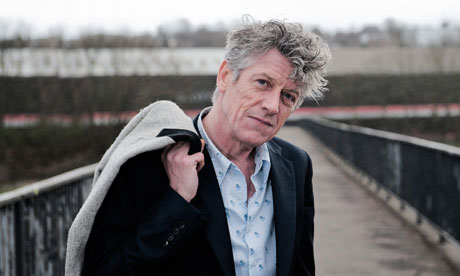
Recently reissued by AED records for Record Store Day 2014, Roddy Frame’s 2002 album Surf is a slow- burning masterpiece that everyone should hear, argues Philip Cummins
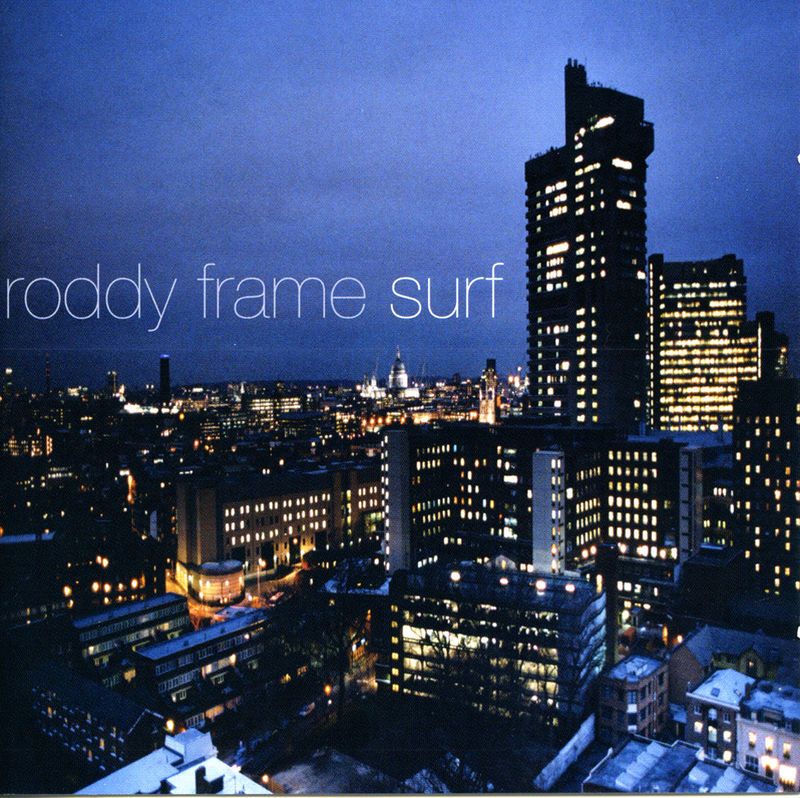
“Majestic”: Surf by Roddy Frame.

…I’ve written an album about day-to-day life in London; about being 38 and wondering what you’re going to do next.

RODDY FRAME claimed the above in a 2002 interview with the Guardian’s Will Hodgkinson before the release of Surf, his second solo LP proper. Hodgkinson interviewed the then 38 year- old Frame, best known as the wunderkind behind Aztec Camera, in his Notting Hill flat where he wrote and recorded all the songs on Surf, his masterpiece.

Taken from atop Burwash House on Weston Street, London SE1, the cover photograph by Hannah Grace Deller (Frame’s then girlfriend), depicts the London skyline in all its twilight beauty. To my eyes, the picture captures London on a dreary Tuesday night in November.

In this photograph, as in Frame’s songs, life is going on in other places: the focus is very much on the switched- on lights in rooms across the city. In the context of the bare instrumentation on the songs collected on Surf- solely voice and acoustic guitar- Deller’s photograph, if anything, feels like a point of view shot from Frame’s mansion- block apartment.

Starting point

Surf opens with ‘Over You’, a finger- picked tune that conveys a rejected lover’s restlessness in the wake of a breakup. As mentioned about the above quote from Frame, the album itself constantly gives a sense that life is continuing in other places across London in spite of the songwriter’s craft of focusing- in on frozen moments in time. No better an example than the line ‘heard you were out, SW3 / talking about how you were over me. Similarly, the song’s final couplet (Me stuck on the strand, trying to get through / And make myself understand that I’ve got to get over you) provides the perfect starting place for the albums’ succeeding ten tracks.

Surf‘s title track slows down the pace ever so slightly. Arpeggio’d chord and long vowels in the lyrics give a the sense of yearning that Frame’s words conveys.

Again, however, the focus is very much on London albeit viewing the city, now, through welled- up eyes (The east end squares’ve grown cold and loud / since I lived there with the twilight crowd / The west end lights have lost their wow).

Frame captures that sense of alienation in the city, of being a small fish in a huge pond and craving intimacy, beautifully in the chorus of ‘Surf’ (When I was young the radio played songs for me/it saved me).

‘Small World’, best known as the theme tune from hit BBC comedy series Early Doors, ends an opening trio of songs that nail the tone of the record, lifting the mood just slightly. Frame’s peppers Hopper- esque images of night-hawks in London town throughout the lyric and his voice is simply stunning on this song; his effortless falsetto blending beautifully with the verses, sung in lower octaves. Like ‘Tough’, ‘Small World’ was, perhaps, mooted as a possible single.

The centrepiece

‘I Can’t Stop Now’ is one of the most important songs on Surf and a song that is at the thematic core of the record. Serving as the breaking point of the tension built up in the record’s opening side, ‘I Can’t Stop Now’ is a good example of Frame’s ability to judge the timing of subtle changes in the dynamics of a song. One of the most cathartic and climactic lines in the song (’til the first tear falls) stands alone from the busy opening verses, giving that line more emphasis and more weight. Similarly, the key change in the final chorus is beautifully timed and renews the tone of the chorus; where the listener heard desolation and sorrow in the previous choruses, the listener now hears a tone of acceptance and defiance in the same chorus, two steps higher. It’s a stroke that only a singer and a songwriter of Frame’s talent and experience could pull off.

Influences

Throughout Surf, Frame wears his influences lightly, though obvious exceptions are…well, obvious. Paul Simon looms large on Surf.On ‘Abloom’, which also has qualities in the chord patterns and the finger- picking that recall Nick Drake, there is a hypnotic quality in the rhythm and harmony; there is a jazz-y feel to it. Simon, however, is also there in ‘High-Class Music’, the title of which also carries Simon’s influence in its wise use of demotic language. The opening finger- picked phrases of each verse immediately recall Simon’s ‘The Boxer’. Add in a fast- paced abab rhyme scheme and Paul Simon’s influence in Frame’s writing is undeniable.

Furthermore, Simon is there again in ‘Mixed Up Love’, one of the stand- outs from Surf; the descending scale of the verse is quite similar to the intro to Simon’s ‘America’. ‘Mixed Up Love’ encapsulates everything that Frame claims about “…being 38 and wondering what you’re going to do next.” in his Guardian interview. The end of the chorus, just as in ‘I Can’t Stop N0w’, contains a wonderfully placed spoken line at the chorus’ end: you’d think that I’d know better now.

Finishing on ‘For What It Was’, Frame exudes the kind of simplicity and concise song-writing only found in country music. There’s a soulful, gospel quality to ‘For What It Was’, rich with spiritual imagery and Frame’s own confident, wry voice (And if the prophets knocked my door with all that heaven held in store, / I’d probably ask to see a sample).

Surf

Not since Paul Simon’s Hearts and Bones nor Bruce Springsteen’s Tunnel of Love has there been an album by a singer- songwriter that has explored themes of love, heartbreak and identity as skilfully and masterfully as Roddy Frame has on Surf. One struggles to think of an LP that is so masterfully crafted from the last 10 – 15 years.

So has Surf been unfairly overlooked? Of course, it has though it’s easy to see why. In 2002, the music press was still feverishly long over the so- called new rock revolution, of which only Jack White emerged as a real, world-class, all time talent. The Strokes burned themselves out; the less said about the also- rans the better.

Coldplay, too, had just launched A Rush of Blood to the Head, their best record to date, which took them directly into the big leagues. Combined, Chris Martin and Co.’s world- beating aspirations and the distortion- dark sounds from New York, LA and Detroit drowned out the fragile, natural tones of Frame’s Surf.

If it was Frame’s ambition to freeze 11 moments from London’s bustling, restless and constant metropolis, he succeeded admirably, capturing that sense of heartbreak, of loneliness and relentless self- examination like few songwriters before him. Surf is, quite simply, one of the most moving, spellbinding and memorable collection of songs I have heard in recent years.

Hanging out as a teen in Terri Hooley’s Good Vibrations record store, scoring soundtracks for Soderbergh, including Rodriguez’s ‘Sugar Man’ on a 2002 mix tape compilation ten years before the Oscar-winning ‘Searching For Sugar Man’ documentary…Belfast DJ, composer and producer David Holmes’ musical odyssey has been nothing short of fascinating. With UNLOVED, a new project featuring Keefus Green and Jade Vincent, Holmes’ restless creative mind shows no sign of slowing down. Philip Cummins spoke to Holmes about UNLOVED, blending music with film and the magical experience offered by record shops and vinyl records.

"I think that when you're a kid, you can't explain why you love certain kinds of things; you just respond to the music." David Holmes, DJ, Producer, Composer.

“I think that when you’re a kid, you can’t explain why you love certain kinds of things; you just respond to the music.” David Holmes, DJ, Producer, Composer.

Originally published by Entertainment Ireland, 4th April, 2014. To read the original, click here.

Philip Cummins: What are the origins of the strong relationship between film and music in your work?

David Holmes: I’ve no idea! It was never contrived, I know that much. I never sat down and thought “I want to work with the moving image.” When I grew up in Belfast during the 70’s I wasn’t allowed out on the streets. I ended up consuming so many movies. Growing up in the age of the VHS and the betamax generation…Belfast was just crazy back then. At nighttime, when things were getting really hairy on the streets, I just wasn’t allowed out; my mother would say to me “you’re not going out tonight”. My family home was bombed by Loyalist paramilitaries when I was four years old. We lived on the Ormeau Road, which, of course, is a really mixed area. I loved growing up in Belfast, but I did spend a lot of time watching movies to get away from the night- time realities of where I lived.

But I also used to listen to a lot of movie soundtracks because I enjoyed them. When I was working as a DJ in Belfast, I’d often slip in a bit of Once Upon a Time in America, a bit of Midnight Cowboy. Records like Midnight Cowboy I inherited from my Mum. I was the youngest of ten, so records would trickle their way down to me. I inherited punk rock because my siblings were into The Clash, Sex Pistols, The Damned, The Stooges, so those records were just there for me to discover and I was into soundtracks long before I started producing. When I started producing I was always aware of trying to create something unique within the world of dance music and not trying to be the derivative of the derivative. Soundtracks were a way of trying to do something new with dance music. I used to drop in soundtracks on top of electronic sounds- like the harmonica arrangement on Midnight Cowboy, for example.

And did Good Vibrations, named by Observer film critic Mark Kermode as the best film of 2013, which you scored and produced, give you a sense of that mixture between your 70’s childhood in Belfast and the songs that inspired you?

Good Vibrations was something that I grew up with. The Outcasts I knew through my brothers and I used to see them about all the time. They were my idols at the time when I was 8 years old. I’d see them on the Ormeau Road in their biker jackets and their DM’s. I just thought that they looked so cool. I’d been going down to Terri Hooley’s shop since I was 11. I used to go down on the bus and harass Terri for music and he actually gave me more music than I’d ever paid for. The other turning point for me, though, was when I saw Quadrophenia at 15. The whole mob movement of it all was something that really inspired me. And through that I got into music that I could be apart of : 60’s soul, rhythm and blues, Northern Soul.

Terri once gave me a box of 7 inches that were signed by Lee Dorsey. The first cut of ‘Ride Your Pony’ was in there and Terri gave me that when I was 15; ‘Last Night’ By The Marquees was in there; ‘La La La La La’ by The Blendells; Ray Barretto…all these rare, original 60’s R&B 7 inch records.

Would Terri have recommended you Rodriguez? You included Rodriguez’s ‘Sugar Man’ on a 2002 mix tape / compilation, entitled Come Get It I Got It, ten years before the Searching for Sugar Man documentary…

No, I’ll tell you; I discovered Rodriquez completely by accident in a record store in New York. I was browsing and I came across ‘Cold Fact’. I was intrigued. The owner of the record store played the first track and said “check this out.” He played ‘Sugar Man’ and I thought “Wow…I’m havin’ this!”

You talk about how important it was inheriting records from your siblings; how important Terri Hooley’s Good Vibrations record store was to you; how you discovered Rodriguez. Do you think that downloading and the culture of online listening has taken the magic out of discovering new music?

Totally. I’ll tell you, though, there’s an amazing new record shop called Sick Records in Belfast and it’s fucking class. The main objective of the shop is just stock really great records. Every time I go in there I end up spending over 100 quid. They’ve got loads of really great new releases, compilations…it’s just fucking brilliant.

Good Vibrations still exists, of course, but it’s more of a tourist attraction, now. Terri sells what sells and it’s mostly second hand stuff…it’s more commercial. It’s been a while since there’s been a shop like Sick in Belfast; a shop where new records are just flying out the door. The guy behind is astounded by how successful it’s been.

I think that when you’re a kid, you can’t explain why you love certain kinds of things; you just respond to the music. I think a lot of kids, now, are responding to music by buying vinyl and I do think vinyl is turning a corner that no- one expected. Kids are getting back into vinyl, big time. They’re saying “this MP3 stuff is just rubbish and it’s not good enough”: I want a physical object that’s tangible, I want to see the artwork, the sleeve notes.”

I’m in London at least once a month and I’d often go down to Rough Trade East and to other record shops that I like to visit and I check out new release, things that I’ve just discovered and things that I’ve just read about rather than just buying it online. And you forget that buying records isn’t just about the records: it’s about going down, seeing other people, talking to the fella behind the counter…there’s a whole social component to it that’s just magical. I thought that that had gone, but it’s still brilliant to have it back. I’ve been playing a lot more vinyl, now. We all get caught up in the digital revolution; it’s hard not to. Don’t get me wrong; there’s certain things that digital does well. If you’ve got an iPod, you’ve got your record collection with you on the move and digital is great for making playlists. But if you have a vinyl record in your hand and you put that record on, you realise that you listen to music in a completely different way. It sounds different, it feels different and the act of putting the record on…it feels like a ceremony, almost. So it’s great to have a new, exciting record shop back in Belfast and the guy’s taste is fantastic, which is paramount to opening up a record shop.

Can I ask you about working with Keefus and about how you guys got UNLOVED, your latest project, up and running?

Keefus is a just a really good friend of mine. Without sounding like a dickhead, we’re really good friends on a spiritual level. I met him when I lived in LA for 18 months and we just started making records together. His partner, Jade Vincent, who’s also involved in UNLOVED, has laid down vocals and it really just came together very organically. Keefus is coming over to Belfast for the whole month of May and that month is going to be spent working really hard- every day, without fail- on writing for the different projects that we’re working on: animation movies, feature length, short movies. In fact, I’ve just directed a short movie with Liam Cunningham, Michelle Fairley and David Wilmot. It’s a very, very personal film. It’s funny; it’s very hard to score a movie when the director falls in love with the temp music- I’ve slagged directors off about it in the past. It’s a really common thing. I’ve just directed a film…and I’ve fallen in love with the temp music! And the worst part is that none of it is mine!

UNLOVED, David Holmes’ new project with Jade Vincent and Keefus Green, play Kilkenny’s Set Theatre on Saturday 19 April for a 10pm show.


Originally published by Entertainment Ireland on 24 March 2014. To read the original, please click here

Franz Ferdinand on flying form in Dublin’s Olympia Theatre

TEN YEARS ON since THAT debut, Franz Ferdinand are not the Young Turks they were when they burst onto the scene in 2004: in 2014, Franz Ferdinand is not the trendiest name to drop in Williamsburg, Brooklyn, nor London’s Brick Lane.

What Franz Ferdinand are- and how quickly we can take Glasgow’s finest for granted- are a band brimming with tight tunes: structurally solid songs with more muscular riffs, pulsating rhythms, sing-along choruses and witty lyrics than at which you can shake an irony- laden t-shirt.

Opening with ‘Bullet’, the opening song of the second side of 2013’s return- to- form Right Thoughts, Right Words, Right Action, following 2009’s misstep Tonight: Franz Ferdinand, Kapranos and Co. immediately follow ‘Bullet’ with two cuts from Franz Ferdinand– ‘The Dark of the Matinée’ and ‘Tell Her Tonight’- before returning to Right Thoughts, Right Words, Right Action territory with standout single ‘Evil Eye’. The opening four tunes, correctly, align their 2004 debut with their latest effort, both albums being two sides of the same coin.

Indeed, the Domino Recording Company band draw eight songs from Right Thoughts, Right Words, Right Action, six from Franz Ferdinand, and four each from You Could Have It So Much Better and Tonight: Franz Ferdinand.

What the band demonstrates best at tonight’s sold out show, however, is their intuitive understanding of dynamics. The opening stompers are soon followed by tender ballads ‘Fresh Strawberries’ (Right Thoughts…) and ‘Walk Away’ (You Could Have It So Much Better), confidently omitting ‘Eleanor Put Your Boots On’, their gorgeous 2006 single, stressing the sheer range of their song- writing.

Better still, the band eschew insincere banter with the audience, instead milking the hooks, phrases and middle eights of standout songs with no small amount of sardonic showbiz schmaltz. The opening phrase to ‘Take Me Out’ is played to galleries for well over half a minute, the breaks in the ending hook of a rapturously received ‘Do You Want To’ are repeated at almost a dozen times than the recorded version and the slow- tempo verses of ‘The Dark of the Matinée’ are stressed to give that song’s barnstorming chorus more punch and vigour.

The most telling moment of tonight’s gig, however, comes from the preamble to ‘Fresh Strawberries’, a self- deprecating, a new tune from Right Thoughts… that chronicles the fall from grace of a once thriving mid- noughties band. Dedicating ‘Fresh Strawberries’ to tonight’s support act, Leeds quintet Eagulls, Kapranos sings the opening verse of We are fresh strawberries / Fresh burst of red strawberries / Ripe, turning riper in the bowl / We will soon be rotten / We will all be forgotten / Half remembered rumours of the old.

Of course, no- one here, tonight, really believes that Franz Ferdinand is noughties survivors; rather, I expect they think that the Glaswegian lads done good have still got the right tunes, right moves and are hitting all the right notes.

Originally published on State.ie. To read the original, please click here.

San Diego rock band Rocket From The Crypt

IN WHAT CAN HARDLY BE DESCRIBED AS A CASH- INRocket from the Crypt reunited in December 2012, beginning their first dates of their reunion tour in April 2013.

Championed back in the 90s by the likes of Dave Grohl – who is consistently linked to on/off rumours about producing Rocket from the Crypt’s comeback record- the San Diego band showed oodles of promise when they signed to Interscope in the mid-90s, even cracking the top 20 in the UK with ‘On a Rope’ and appearing on Top of the Pops; unheard of for a band borne out of the west coast hardcore scene of the 80s/early 90s. Their 1995 breakthrough record, Scream, Dracula, Scream! sounds as fresh and vital, today, as it did back then.

Tonight, there’s no shortage of greying rockabilly quiffs and RFTC t-shirt-clad fans who would probably claim to have bought the original, red-coloured vinyl – deleted immediately after release – of 1995’s once ultra rare, though since reissued, Hot Charity. The band’s set caters, mainly, to those loyal and fervent fans of the band, playing cuts from Scream, Dracula, Scream!, as well as 1998’s RFTC and 2001’s Group Sounds, all of which are well represented tonight. In fact, many of the songs from each album are performed in the same sequence as the records: ‘Straight American Slave’ and ‘Carne Voodoo’ from Group Sounds open the set, while the highlight of the night is a groove in the set created by ‘Middle’, ‘Born in ‘69’, ‘On a Rope’ and ‘Young Livers’, which elicit the loudest cheers of the night from an otherwise reserved audience. An awesome version of ‘I’m Not Invisible’ is a reminder, like the best cuts from Scream, Dracula, Scream! of the band’s ability to write instantly catchy songs that get the audience on their side from the get-go.

Clad in black shirts featuring Chinese dragons, the band members look like a gang and, in 2013, they must seem an anomaly among younger groups, now, that lack the uniformity, and that sense of identity that was has been central to Rocket from the Crypt as a unit. Unfortunately, the core problem throughout tonight’s set, however, is the sound. What set Rocket from the Crypt apart from any other American rock band of their time was their use of a brass section in the form of saxophonist Apollo 9 (Paul O’Beirne) and trumpeter JC 2000 (Jason Crane), both of whose instruments are far too low in the mix to have the impact that they have on record. Similarly, frontman Speedo’s vocals are slightly shot from previous gigs on their recent tour and, again, his vocals are consistently overshadowed by the guitars and by the drums.

An extended version of ‘Come See, Come Saw’, again, lacks the punch and power of the brass section, though the band use the recurring bass riff as an opportunity to loosen up the set and make it seem loose and unpredictable. Speedo interacts with the audience in irony- laced showbiz theatrics, including directing the audience into dance routines.

Eschewing such bravado, Speedo salutes the audience for one last time during the night. “Thanks for not forgetting about us”, he says as he parts from the stage, somewhat confirming the band’s status as 90’s rock survivors. And if rumors of a Grohl- produced comeback album do come to fruition, it won’t be the last time Speedo is saluting his audience from the stage.

Originally featured in the online edition of the Irish Post.

Clad in a chic leather jacket and dark-rimmed glasses and swinging her hips down stage right to bassist and collaborator Paul Bryan’s down stage left, Aimee Mann betrays her 52 years. Youthful and sprightly, she appears as a cross between the ethereal, angelic Emmylou Harris and the geeky charm of Elvis Costello; like the former, she posses a strong, commanding voice; like the latter, her work, unfortunately, ranges from the remarkable to the forgettable.

In what is a fully seated show, Mann has her loyal and devoted fan base- who have, no doubt, journeyed with Mann through her eight albums of output, including 2012’s patchy release,  Charmer- in the palm of her hand from opener ‘Disappeared’. In what is very much a show of two halves, Mann’s set unequal. The first half draws primarily from Charmer and 1995’s I’m With Stupid, including the latter’s ‘You Could Make A Killing’, which Mann has previously claimed was written about her one- time infatuation with Noel Gallagher.

While it’s clearly evident that Mann knows her way with  the fundamentals of Power Pop; that is, 4/4, mid- tempo, major key, blues- pop that owes much to the classic I-IV-V major progression, it all feels slightly samey: the song arrangements are too similar to each other, and Mann’s unremarkable tunes bleed into one another. There is also a distinct lack of surprise and both Mann and her band look very much on auto pilot.

True, Mann is a crafty wordsmith, so it’s unfortunate that her literate lyrics, including much of her narrative- driven tunes from her concept album about a journey man boxer, The Forgotten Arm, are drowned out in the mix by two keyboard players, particularlyCharmer’s title track, which is laden in Moog synthesizer sounds. Indeed, the selections from Charmer are full of the kind of sneering, self- deprecating cynicism that defined the best songs of Soft Rock and New Wave, but which is distinctly lacking in pop songs today. That said, however, there are sloppy, hackneyed metaphors and clichés abound, such as ‘Labrador’ and the album’s title track. Clearly, quality control is an issue, and one gets the feeling that a writer of Mann’s calibre and experience should know better.

All is not lost, however. When Mann’s backing band leave the stage, Mann performs selections from her soundtrack to Magnolia, Paul Thomas Anderson’s 2000 masterpiece, and the soundtrack’s companion album, 2000’s Bachelor No. 2. During the descending G minor / G seventh minor introduction to ‘Save Me’- Mann’s Oscar-nominated song and, arguably, her best-known song- Mann indulges her audience in a spot of light- hearted jibes aimed at Phil Collins, who beat her to the Oscar. Rivaled only by Wilco’s Jeff Tweedy, Mann makes an excellent raconteur. A craft in itself, Mann’s on- stage banter between songs diffuses the intensity of her tunes, allowing her to present and perform her songs in a way that is inclusive and, above all, entertaining.

Not only is it refreshing at this point of the set that Mann’s lyrics can finally come through in the mix, but the stripped down and sonically arresting arrangements of the Magnolia and material open up an infinitely more interesting dimension to Mann’s material. Indeed, ‘Wise Up’, a seminal, Solo- piano song, which was an integral soundtrack to a defining sequence in P.T. Anderson’s sprawling movie, has Mann’s Dublin audience spellbound and in awe. Finally, the gravitas of Mann’s mature and oaky voice can take centre stage.

After what can only be the most resounding round of applause of the night, Mann’s band once again grace the stage for Mann’s cover version of Harry Nilsson’s ‘One’, which features in the opening credits of Magnolia. As the lush harmonies, tremolo- heavy guitar, swelling organ and crashing symbols all work together to build during the song’s chorus, one can’t help but feel that this is the band at their most interesting, exciting, suspenseful and less predictable. It is this kind of sweeping, sonically diverse material that is lacking in Mann’s catalogue.

Gamely taking requests from audience members, Mann’s audience of die- hards call out songs so obscure that Mann no longer knows how to play them. Eventually, Mann settles on ‘Invisible Ink’ from 2002’s Lost in Space. Keeping feel- good vibe of the night alive, she recalls her trip earlier in the day to the statue of Phil Lynott outside Bruxelles on Dublin’s Harry Street before launching into a cover of Thin Lizzy’s ‘Honesty is No Excuse’ with support act Ted Leo playing Eric Bell’s audacious lead guitar parts. Earlier in the night, Leo had provided backing vocals on Charmer’s ‘Living a Lie’, which, on record, features backing vocals by The Shins’ James Mercer.

Closing on a dizzying high with Bachelor No. 2 highlight ‘Deathly’, complete with one of the best opening lines ever written in song (Now that I’ve met you / Would you object to / Never Seeing each other again),  Mann makes up for the lyrical shortcomings of recent material.

Fans may not have long to wait until Mann’s work graces the Grand Canal Theatre again: a stage musical, adapted from her 2005 album The Forgotten Arm and written in collaboration with heavily in- demand Hollywood screenwriter Aaron Sorkin (The Social Network), might be with us soon. And while Charmer may not be enough to win Mann new admirers, the savvy Virginian certainly has the songs and stagecraft to remind those who take her granted of her mercurial talent.

Born again: John Mayer’s fifth studio album, ‘Born and Raised’, is a return to form.

Having almost successfully recovered from his disastrous and downright bizarre February 2010 Playboy interview, removing himself from Hollywood’s A- list party circuit and selling his bi- coastal homes L.A. and New York in favour of a self- imposed, frugal lifestyle in Bozeman, Montana, John Mayer has spent the ensuing time eating humble pie; nowhere is this more evident than on his fifth record, Born and Raised, his most focused, mature, honest and fully realised album to date.

On opener ‘Queen of California’, Mayer sets out his stall; this is an album in the vein of the big, era- defining folk albums of the 70’s, such as Neil Young’s Harvest, James Taylor’sSweet Baby James and the debut solo records of Stephen Stills and Paul Simon. Mayer’s subtle finger- picking and references to Neil Young (Looking for the sun that Neil Young sung/ After the gold rush of 1971), Blood on the Tracks– era Bob Dylan (If you see her, say hello) and Joni Mitchell (Joni wrote Blue in her house by the sea/ I got to believe there’s another color waiting on me) all convey a move towards the confessional, folk song- writing that defined Mayer’s career with 2003 hit ‘Daughters’ but was subsequently sidelined in favour of the audacious blues chops he displayed on 2005’s live album, Try!, and the more restrained, soulful blues playing of 2006’s Continuum– arguably his best record- which earned him a place on Rolling Stone’s New Guitar Gods, with the nickname “Slowhand Jr.”- a favourable nod to that other blues guitarist who crossed over to modern, mainstream audiences.

Throughout Born and Raised, Mayer shows an astute understanding of styles and forms. Like ‘Queen of California’, ‘Something Like Olivia’ uses that most humble and honest of all song forms; 12- bar blues. ‘Something Like Olivia’ finds Mayer attempting to resolve his devil- may- care, man- about- town- urges of old, with his newly found moral order and conduct. Of course, this turns out to be a theme at the heart of the record; that one person’s redemption can only be achieved by progressing past life’s unfortunate choices and by chalking those mistakes down to life experience. Mayer illustrates this best in ‘The Age of Worry’, a simple, AB- form song, which is laden with strong, Dylan-esque rhetoric (Know your fight is not within/ Yours is with your timing/ Dream your dreams but don’t pretend/ Make friends with what you are).

Flagship single ‘Shadow Days’, the style and sound of which is clearly influenced by George Harrison and Jeff Lynne, is certainly the most colourfully arranged and produced songs on the first side. It is, however, the album’s title track, with harmonies courtesy of Graham Nash and David Crosby, which is one of the strongest songs here and might just be one of the best songs that Mayer has yet written. The gorgeous harmonies, Mayer’s soulful vocal inflections and the acceptance and honesty of his lyrics all melt fluidly and forcefully to conclude the first side.

The second side finds Mayer embracing slow- tempo numbers that, again, tip the hat to his many writing influences. Despite it’s- frankly- awful title, ‘Love is a Verb’ is exactly the kind of song that Mayer needs; a slow burning, breezy, ‘Wonderful Tonight’- mode Clapton song. This is followed by ‘Walt Grace’s Submarine Test, January 1967’, a song, which in its rhymes, its unusual, intriguing, opening saxophone arrangement and narrative- driven lyrics of hope and aspiration owes much to Paul Simon. Darkness reigns over the brooding ‘Whiskey, Whiskey, Whiskey’, the chorus of which recalls Jeff Buckley’s ‘Lover, You Should Have Come Over’.

After showing restraint and subtlety in his playing throughout the record, Mayer finally lets himself off the leash on ‘A Face to Call Home’ with some of the most operatic playing on the record that, temporarily, shifts away from the Americana sound that dominatesBorn and Raised, for a delay- laden, stadium- rock outro, reminiscent U2’s The Edge.

The recurring theme of identity and the inevitable dichotomies- born and raised, folk and blues, fame and anonymity, the public self and the private self- that dominate Born and Raised culminate in ‘Born and Raised (Reprise)’, an alternate version of the title track, which, here, is treated as West Coast folk ditty that is as enjoyable to hear as it must have been to record.

Despite going “Americana” and producing his strongest set yet, Mayer might be too divisive a figure in contemporary music to appreciated by fans of Neil Young and Ryan Adams; too unfashionable to persuade those music fans that he’s anything other than a Berklee College of Music- educated pretty-boy, who is molly- coddled by his major label and who is more famous for his appearances in TMZ, People magazine, US Weekly and many other celeb gossip magazines. On Born and Raised, however, Mayer does do enough to prove that there is substance in his song- writing and guitar playing. Now, more than ever, mainstream American radio and television- now more than ever- needs a major label, Billboard Top 100- topping song- writer and performer of Mayer’s talent and substance to enrich and subvert a mainstream dominated by vacuous, auto- tuned, shock and awe value, pop- tarts. The John Mayer of Born and Raised might even appreciate this dichotomy.

Paul Buchanan

Walking on air: Blue Nile singer- songwriter Paul Buchanan is back with his debut solo album, Mid Air.

In his essay ‘The Blue Nile: Family Life’, Marcello Carlin observes that “On every Blue Nile album there is a moment where time stops, and emotion laid open and bare”. Eight years on from The Blue Nile’s previous- some say last- ever- album High, Paul Buchanan, the band’s singer- songwriter, has finally delivered the solo album that many long- time fans of The Blue Nile have anticipated. Buchanan’s Mid Air is an album of thirteen, three- minute, piano- led songs and one instrumental, all of which get to straight to the heart of Carlin’s astute observation.

Recorded by Cameron Malcolm (son of long- time Blue Nile producer/engineer Calum Malcolm), the success of Mid Air is largely down to the compression and brevity of Buchanan’s songs, which are as condensed and companionable as short lyric poems. The minimal arrangements that adorn each song eschew the sometimes too slickly produced, glossy feel of subsequent Blue Nile records. Mid Air‘s opening title track features a beautifully restrained vocal from Buchanan, underpinned by light, electronic, orchestral strings. Like Tom Waits- whose collective influence of Frank Sinatra looms large on Mid Air– Buchanan delicately croons and plays simple, elementary scales to stunning, emotionally intense effect, most evidently so on album highlight ‘Cars in the Garden’.

Initially given the working title of Minor Poets of the 19th Century (after a book that Buchanan bought in his local Oxfam) Buchanan’s literate lyrics recalls Larkin (‘Wedding Party’), Plath (‘Two Children’) and Yeats (‘My True Country’). Before recording Mid-Air, a close friend of Buchanan’s passed on; no surprise, then, that, lyrically, the tone and mood of Mid Air is elegiac. Buchanan, however, extends the mournful tone beyond bereavement; ‘Newsroom’ is a lament for the last days of print journalism (Last out the newsroom/ Please put the lights out/ There’s no- one left alive), while ‘My True Country’, featuring one of Buchanan’s most impassioned and convincing vocal performances, celebrates an imagined paradise. The portrayal of urban loneliness in the full glare of neon signs during the night- time hours- a central and defining characteristic of a Blue Nile song- is mostly absent on Mid-Air, save for ‘Half the World’ and the superb album- closer, ‘After Dark’.

In Mid-Air, Buchanan has crafted an accomplished collection of beautiful, honest songs that, like Joni Mitchell’s Blue and Tom Waits’Closing Time, rely heavily on the strength of their lyrics, their simple arrangements, and humble, delicate, fragile, convincing vocal performances. A Mercury Music Prize nomination must, surely, be mid- air.

Also available in State.ie


Billed in all but name as a rock dinosaur double-header, Bob Dylan and Mark Knopfler’s opening show of their joint European tour is no doubt one for blues fans with deep pockets. Blues music- American roots music, in general- flows deep for both Dylan and Knopfler, the latter exploring American roots music more ardently since he left Dire Straits in 1995. Indeed, Knopfler produced and collaborated with Dylan on the latter’s 1979 and 1983 records, Slow Train Coming and Infidels, respectively, at a time when Dylan’s career had hit its nadir and Knopfler was about to break the big time with Dire Straits.

Ahead of the night’s main attraction and performing separately, Knopfler takes to the stage with a band not too dissimilar in sound and feel as Dylan’s. Currently taking time out from recording his next record, Knopfler draws heavily from the solo career he first pursued with 1996’s Golden Heart in a live set that gels well with the sound, songs and feel of Bob Dylan’s records and live shows of the last 10 years. Although those expecting ‘Walk of Life’ or ‘Sultans of Swing’ might have been disappointed by the distinct lack of hits, Knopfler’s folk-leaning roots music shuffles along, opening with ‘What Aye Man’ from 2002’s The Ragpacker’s Dream. Debuted from, presumably, the current sessions for his next record, ‘Corned Beef City’ and ‘Privateering’ both feel fully realised and suggest that his preoccupation with folk / blues / Americana is a long way from being over.

Sauntering onstage to the theatrical and now routine stage announcement that condenses Dylan’s 50-year music career into a matter of sentences, Dylan and his band of session players kick off the night with an excellent rendition of ‘Leopard-Skin Pill-Box Hat’. The dramatic opening is followed swiftly by a restless, shuffling and countrified ‘Don’t Think Twice, It’s All Right’, which shows Dylan’s voice to be more full, warm and defined than shows of recent years.

Dylan then moves away from the organ, which he has been stood at like Jerry Lee Lewis, and takes centre stage for ‘Things Have Changed’, the song which landed him an Oscar almost ten years ago, to a warm applause. The phrasing, as has been the case with Dylan’s performances for some time, is rapid fire. At times, his delivery is awkward and betrays the studio recordings to the point where it may take time to figure out which song it is he is performing. ‘Tangled Up In Blue’ falls victim to Dylan’s re-phrasing, though, tonight, the chorus retains the melodic punch of the studio recording yet has the Chess Records feel that Dylan has sought on almost all of his records since 1997’s career changing Time Out of Mind.

The junk yard-blues of ‘Beyond Here Lies Nothin’’ is reminiscent of ‘Swordfishtrombones’-era Tom Waits and Dylan gives the set a lift in the right place, only for it to dip again with a pedestrian performance of ‘Spirit On The Water’ from 2006’s Modern Times. However, Dylan and his cowboy band soon gain momentum again with ‘Desolation Row’, ‘Highway 61 Revisited’, ‘Thunder On The Mountain’ and ‘Ballad Of A Thin Man’ forming a groove in the set that finds Dylan and his band peaking just before the night’s encore.

With Mark Knopfler on the bill, there’s an expectation that he might join Dylan for an encore of Infidels lead single ‘Jokerman’ or perhaps ‘Blind Willie McTell’, a lost Dylan outtake from theInfidels sessions, which Knopfler co- wrote with Dylan. Disappointingly, it doesn’t happen, though Dylan and his merry men take to the stage for an encore of ‘Like A Rolling Stone’ and ‘All Along The Watchtower’, the former which raises the roof off the house, the latter trailing off into mid bursts of blues playing from Dylan’s band.

Dylan’s refusal to engage with his audience means that he doesn’t attract the same adulation, live, which Leonard Cohen, for example, has courted on stage during his touring of recent years. The distance that he keeps from his audience is so that one could sympathise with the steady stream of fans leaving the venue before the night’s end (no doubt insulted by Dylan’s perceived contempt for his audience and frustrated at how foreign the sound and arrangements of some of the songs sound in comparison to studio recordings). What they don’t realise, however, is that though Dylan has appeared to us in many guises, he is still the same uncompromising rebel he always was. Dylan has managed to integrate his vast catalogue of songs to the point where they are all, consistently, in dialogue with one another. Although Dylan’s next move, in terms of recording or completing his long-overdue second installmentChronicles is vague, he will surely continue to play live in the same style and feel as he has for, at least, the last 10–15 years. His success at achieving his singular vision for his songs that he feels he needs to keep the material fresh, coupled with the appetite that he still has to play live, suggests that his so-called Never Ending Tour won’t be winding down anytime soon.

Originally published by State.ie

Setlist for Bob Dylan – Live at The O2, Dublin, October 6th, 2011

  1. Leopard-Skin Pill-Box Hat
  2. Don’t Think Twice, It’s All Right
  3. Things Have Changed
  4. Tangled Up In Blue
  5. Beyond Here Lies Nothin’
  6. Spirit On The Water
  7. The Levee’s Gonna Break
  8. Desolation Row
  9. Highway 61 Revisited
  10. Forgetful Heart
  11. Thunder On The Mountain
  12. Ballad Of A Thin Man
    Encore:
  1. Like A Rolling Stone
  2. All Along The Watchtower
Setlist for Mark Knopfler – Live at The O2, Dublin, October 6th, 2011
  1. Why Aye Man
  2. Cleaning My Gun
  3. Corned Beef City (New Song)
  4. Sailing to Philadelphia
  5. Hill Farmer’s Blues
  6. Privateering (New Song)
  7. Song for Sonny Liston
  8. Done With Bonaparte
  9. Marbletown
  10. Speedway at Nazareth

Stephen Malkmus and the Jicks – Mirror Traffic

(Domino)

No doubt refreshed and inspired from Pavement’s 2010 reunion, Stephen Malkmus’s fifth solo LP finds the former Pavement frontman more cohesive and tune- based than 2008’s overblown and indulgent Real Emotional Thrash. Produced by Beck (that other poster boy for US indie- rock slackers), Malkmus’ 15-track, solo record – made up largely of accessible, three-minute pop songs – is a welcome return to the sound that made his music so endearing in the first place. Flagship single ‘Tigers’, with its opening line of ‘I caught you streaking in your Birkenstocks’ is more Pavement than Pavement themselves, while the slide guitars on the chorus are equally reminiscent of both Silver Jews and, indeed, Beck’s more roots-based material. The choice of an experienced songwriter like Beck as the producer has certainly paid off; throughout, Malkmus shows his range as a songwriter. ‘Senator’ is a reminder of Malkmus’ lyrical skills as a ribald social critic of Middle America, while ‘Asking Price’ and ‘Fall Away’ are amongst the most tender and cool songs that Malkmus has ever written.

Beck’s presence throughout the record is there, both musically and in spirit. The jaded folk/country of ‘No Is (As I Be Are)’ and ‘Long Hard Book’ could have easily been taken from the producer’s Mutations while the instrumental ‘Jumblegloss’ seems like a musical exercise between both artists. Although it might be three tracks too long and the second half lacks the punch of the first, Mirror Traffic will no doubt appeal to those currently caught up in a nineties nostalgia trip and is certainly Malkmus’ most enjoyable and infectious set of songs as a solo artist.

Originally published by State.ie

(Conchord)

In a telling lyric on his eleventh solo studio record, Paul Simon imagines God cruising down a highway in the Midwest of America, criticising American culture: “check out the radio, pop music station / That don’t sound like my music to me.” In one of many lyrics in which Simon uses a mythic figure to reflect his personal conflicts with America, it neatly sums up the tone of So Beautiful Or So What. Repeatedly throughout, Simon is reaching back into his musical past as a way of reacting to the present. Simon even delves back to the ‘40’s, sampling a sermon given by Reverend J.M. Gates on ‘Getting Ready for Christmas Day’. The jaunty opening track recalls Simon classics such as ‘Mother and Child Reunion’ and ‘Kodachrome’ and touches on everything from life in Blue Collar America to Iraq in just over four minutes. Re- uniting with Phil Ramone, who produced all of Simon’s solo records from 1972’s Paul Simon to 1980’s One Trick Pony, the feel of So Beautiful Or So What is similar to his early ‘70’s debut; it seems almost as if the record was recorded live, in a room.

Pushing 70 years of age, Simon clearly has mortality on his mind. Like many songwriters of his era, songs about birth, death and everything in between are sure at this point in his life. What makes Simon’s take on the subject, so refreshing is how he writes about the big questions with a humorous voice that is indelibly his own. In ‘The Afterlife’, he imposes witty, smooth, demotic tones on life after death: “Had to stand in line / just to glimpse the divine / what ‘cha think about that?”. Again, Simon reaches to the language of a bygone era and the coda of “Be Bop a Lula? Or ooh Papa Doo?” immediately recalls the iconic opening cry of “A-wop-bop-a-loo-bop-a-lop-bam-boom!” from Little Richards’ ‘Tutti Frutti’.

Unlike much of his output since Graceland, the lyrics, melodies and guitar parts are not overshadowed in the mix by the rhythm section. Simon returns to his songwriting approach of constructing the song before the rhythm; an approach which changed during sessions for 1986’s classic Graceland, whereby rhythm dominated and dictated the course of the song. Songs such as ‘Love and Hard Times’, ‘Questions for the Angels’, and instrumental ‘Amulet’- have no percussion at all, and there is no bass guitar anywhere on the record.

Lyrically, Simon is, as ever, concerned with the present state of America but is consistently using reference points from the past and in doing so write some of his most vivid and moving lyrics. His humorous and playful tone- particularly on ‘The Afterlife’ and ‘Rewrite’, a stunning song about a Vietnam vet writing a fictional happy ending for his autobiographical film script is akin to that other maestro of American Song: Randy Newman. The piano-led ‘Love and Hard Times’ is laced with the same sardonic humour of Newman’s ‘God’s Song (That’s Why I love Mankind)’. Where Simon’s “restless Lord,” says “…anyway, these people are slobs here / if we stay, it’s bound to be a mob scene”. A frank social commentator, Simon’s observations throughout the record ensure longevity.

An old hand at making records, Simon knows that the greatness of an album rests on the finishing side. ‘Amulet’, an elegant instrumental, bridges the raucous bluegrass of ‘Love is An Eternal Sacred Light’ with ‘Questions for the Angels’, easily one of his most tender and beautiful compositions. He finishes on the album’s title track, the recurring hammer, on the motif of which is reminiscent of the opening theme of Simon & Garfunkel’s ‘Mrs. Robinson’. By the end of the albums, ten tracks clocking at 38 minutes, it’s clear that Simon’s blend of bluegrass, shifting rhythms, poetic lyrics and confessional, solo acoustic centrepieces are almost a retrospective of his entire solo output. It’s also clear that he has crafted his most vital, most complete album in 25 years.

Originally published on State.ie